

Most homeowners booking a cleaner for the first time ask the same question before anything else. Not how much it costs, not what products get used, but how long a stranger is going to be in their home. It is a fair question. You want to plan your day around it, and you want to know whether the time you are paying for actually matches the work being done.
The honest answer is that it depends on a handful of specific factors, and once you know what they are, you can estimate your own visit fairly accurately. A typical regular home cleaning visit in Guelph runs somewhere between two and four hours for one cleaner, though the real number for your home could sit outside that range in either direction. For a closer look at how a standard visit is structured, Clenza Home Cleaning in Guelph breaks down what a routine visit covers before you book.
What Actually Changes the Time a Cleaning Takes
Square footage is the factor most people assume matters most, and it does play a role, but it is rarely the deciding one. A tidy nine hundred square foot condo with two people living in it can take less time to clean than a cluttered fifteen hundred square foot house with a dog, three kids, and a home office that has not been organized since spring.
The things that actually move the needle are the number of bathrooms, since bathrooms take disproportionately long to clean properly, the amount of clutter on counters and floors that has to be moved before a surface can even be wiped, how long it has been since the last professional or deep clean, and whether pets are in the home shedding hair onto every soft surface. A home with three bathrooms and heavy pet hair will almost always take longer than a larger home with one bathroom and no pets, even if the square footage tells a different story.
The number of cleaners sent also changes the math. A team of two working together does not simply cut the time in half, since some tasks like vacuuming a hallway or wiping down a single kitchen only need one person regardless of how many are on site, but it usually brings the total visit time down noticeably compared to one cleaner working alone.
Average Cleaning Times by Home Size in Guelph
These ranges assume a home in reasonably normal condition, meaning it is not a first time deep clean and not a home that has gone months without any attention. They are meant as a planning guide, not a guarantee, since every home is different.
A studio or one bedroom apartment typically takes one to two hours with a single cleaner. Most of that time goes into the kitchen and bathroom, since the living and sleeping areas in a smaller space clean up quickly once surfaces are cleared.
A two bedroom home or townhouse usually falls between two and three hours. This is the most common booking size in Guelph neighbourhoods like Clairfields and Kortright Hills, where a lot of young families and professionals live in similarly sized homes.
A three bedroom home generally takes two and a half to three and a half hours for a single cleaner, or noticeably less with a two person team. This size tends to have more bathrooms and more lived in rooms, which adds time even when the layout is efficient.
A four bedroom or larger home can run three to five hours depending on how many bathrooms it has and how much of the home gets a full clean versus a lighter pass. Larger Guelph homes in areas like Westminster Woods and Kortright East often fall into this range.

These numbers are for a regular maintenance style clean. A deep clean or a first time visit takes longer, sometimes close to double, because it involves work that a routine visit does not, such as scrubbing built up grime, cleaning inside appliances, and detailing baseboards and trim that get missed during normal upkeep.
What Happens During a Regular Home Cleaning Visit
A regular cleaning visit is not the same scope of work as a deep clean, and understanding the difference helps explain why the time ranges above look the way they do. A standard visit focuses on maintaining a home that is already in decent shape rather than restoring one that has fallen behind.
That typically means wiping down kitchen counters, the stovetop, and the outside of appliances, cleaning and disinfecting bathroom sinks, toilets, tubs, and mirrors, vacuuming carpets and rugs, mopping hard floors, dusting reachable surfaces and furniture, making beds if requested, and emptying visible trash. It does not usually include tasks like moving furniture to clean behind it, cleaning inside the oven or fridge, or scrubbing grout, since those fall under a deep clean instead. The full breakdown of what is and is not included in a standard visit is outlined on the Regular Home Cleaning, which is worth checking before your first booking so there are no surprises about scope.
Knowing this scope matters because it explains a common source of confusion. Homeowners sometimes expect a two hour regular visit to produce the same result as a five hour deep clean, and when it does not, they assume the cleaner rushed. In reality, the two services are doing different jobs. A regular visit maintains a clean home. A deep clean restores one.
First Time Cleanings Take Longer Than Recurring Visits
If this is your first time booking a cleaner, expect the visit to run longer than the ranges above suggest, sometimes by an hour or more. A home that has never had professional attention usually has buildup in places that get skipped during day to day tidying, like inside window tracks, behind toilets, along baseboards, and on light switches and door handles.
Once that first visit resets the baseline, recurring visits on a weekly or biweekly schedule tend to get faster and more consistent over time. This is one of the practical reasons cleaning companies recommend a regular schedule rather than only booking occasionally. A home cleaned every two weeks rarely reaccumulates the kind of buildup that slows a visit down, while a home cleaned once every few months essentially resets to first time conditions each time.
How Professional Cleaners Finish Faster Than Most Homeowners
A common question homeowners have is how a professional cleaner covers an entire home in a few hours when the same job might eat up an entire Saturday for the person who lives there. The answer has less to do with rushing and more to do with method.
Professional cleaners work a home in a set order, typically top to bottom and back to front within each room, so they never reclean a surface that dust or debris has already fallen onto. Someone cleaning their own home without a system often works in a random order, dusting a shelf after already vacuuming the floor beneath it, which means the floor gets vacuumed twice or the dust just gets tracked back onto it.
They also do not stop to make decisions mid task. A homeowner cleaning a kitchen might pause to sort mail, figure out where an item belongs, or get distracted by something in another room. A professional working on a schedule moves directly from one task to the next without those interruptions, which adds up to real time saved over the course of a visit.
Tools and products matter too. Professional cleaners carry equipment suited to specific surfaces and know which products cut through grease or soap scum without multiple passes, rather than relying on a single all purpose spray for every surface in the home.
Finally, when two or more cleaners work together, they divide the home by area rather than by task, so one person is not waiting on another to finish before starting their section. This kind of division is one of the simplest reasons a two person team finishes well ahead of what the combined hours would suggest if the work were done sequentially.
What Slows a Cleaning Down
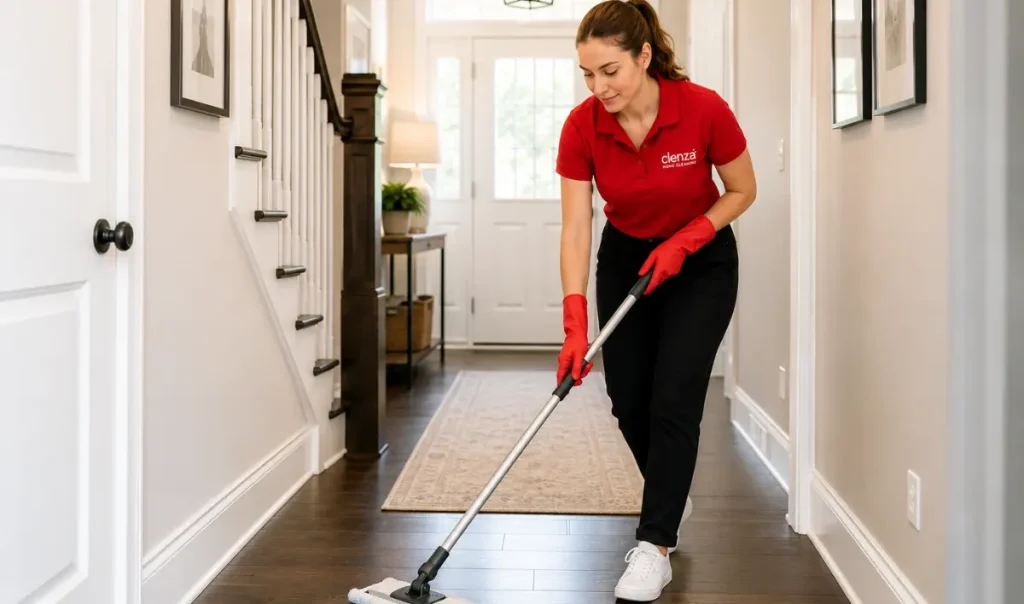
A few conditions reliably add time to a visit regardless of home size. Heavy clutter is the biggest one, since a cleaner has to spend time moving items off a counter or floor before the actual cleaning of that surface can begin. This is time spent handling belongings rather than cleaning, and it is the single easiest thing a homeowner can control before a visit.
Pet hair is another common factor, particularly in homes with cats or dogs that shed onto upholstery, carpets, and blinds. It often takes an extra pass with specific tools to fully lift embedded hair from soft surfaces.
A long gap since the last cleaning, whether professional or otherwise, also extends the visit, since dust, soap scum, and kitchen grease build up gradually and take longer to remove the longer they have been sitting. And homes with a lot of intricate surfaces, such as detailed trim, textured walls, or many small decorative items that each need to be dusted individually, take longer than homes with simpler, more open surfaces of the same square footage.
Does the Season Change How Long a Cleaning Takes in Guelph
Guelph homeowners often notice their cleaning visits run a little differently depending on the time of year, and there is a real reason for that beyond coincidence. Late fall and winter bring road salt and slush indoors on boots and paws, which means entryways and floors near doors need more attention than they do in summer. Homes with a lot of window space also tend to show more streaking and condensation buildup during Guelph’s colder months, which can add a few extra minutes to window and sill cleaning.
Spring carries its own pattern. After a winter of closed windows and less airflow, many homes accumulate more dust than usual, and this is part of why spring cleaning requests often run slightly longer than a routine visit at other times of year. None of this changes the core scope of a regular clean, but it is worth keeping in mind when comparing how long a visit took in July against how long the same size home took in February.
Why Condos and Apartments Sometimes Clean Faster Than Houses
Homeowners comparing notes with a neighbour in a detached house sometimes wonder why their condo or apartment visit finished sooner despite having similar square footage on paper. Layout is usually the answer. A condo typically has fewer exterior walls to dust along, fewer stairs, and often only one or two bathrooms regardless of how many bedrooms it has, since builders tend to be more conservative with bathroom count in multi unit buildings than in detached homes of the same size.
Shared building features also play a role. Building staff usually handle common hallways, elevators, and lobby areas, which means a cleaner working inside a single unit is only responsible for the interior square footage rather than any shared space. This is one of the reasons condo and apartment cleaning visits in Guelph’s downtown core and near the University of Guelph tend to sit at the shorter end of the ranges described earlier in this guide, even when the unit itself is a reasonably generous size.
How To Get the Most Out of Your Scheduled Time
Homeowners who want their cleaning time spent entirely on actual cleaning, rather than on preparation, tend to do a few things before the cleaner arrives. Clearing counters and floors of loose items lets the team start cleaning surfaces immediately instead of tidying first. Putting away laundry and dishes has the same effect. Securing pets in one area for the first part of the visit can also help the team move efficiently through rooms without interruption.

None of this is required, and a professional cleaner will still do a thorough job in a lived in home. But a few minutes of light tidying before arrival is the most direct way to make sure your scheduled hours go entirely toward cleaning rather than organizing. If you are deciding between a one off visit and an ongoing arrangement, the Our Services page outlines the full range of options available in Guelph, and the Deep Cleaning vs Regular Cleaning guide is a useful next read if you are still deciding which type of visit your home actually needs.
It is also worth noting how much time cleaning represents in the average Guelph household to begin with. According to Statistics Canada’s Time Use in Canada data, unpaid housework remains one of the largest single categories of time Canadians spend outside of paid work and sleep, which is part of why so many households eventually look at outsourcing at least part of that load to a professional service.
Frequently Asked Questions About Cleaning Time in Guelph
How long does a two hour cleaning cover in an average home?
A two hour visit is usually enough for a smaller apartment or a well maintained two bedroom home on a recurring schedule. It typically covers the kitchen, one or two bathrooms, general dusting, and floors, though it may not stretch to a full deep clean of every room.
Can a house actually be cleaned properly in three hours?
Yes, for most two to three bedroom homes in reasonably normal condition, three hours with one cleaner or less with a team is a realistic amount of time for a regular maintenance clean. A first time visit or a heavily cluttered home may need more.
Does tidying before the cleaner arrives actually save time?
It does, though it does not reduce the price of a scheduled visit. Clearing surfaces means the team spends their time cleaning rather than moving items out of the way first, which often results in more thorough coverage within the same visit.
Why did my last cleaning take longer than expected?
The most common reasons are a longer gap since the previous clean, more clutter than usual, or additional requests made on the day of the visit. Any of these can extend a visit beyond the typical range for a home of that size.
If you are trying to work out roughly how long a visit will take in your own home, the safest approach is to think about bathrooms, clutter, and pets first, and square footage second. A home in Guelph that checks those boxes well will almost always land near the shorter end of the ranges above, and one that does not will land closer to the longer end, regardless of how big or small the home actually is.